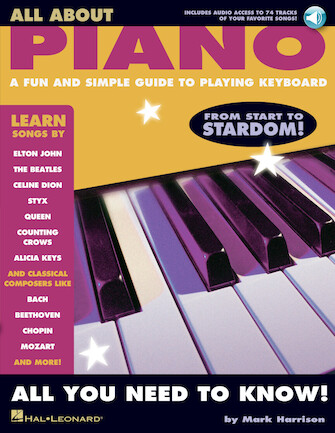
All About Piano is Mark Harrison's antidote to tedious lesson books — a fun, encouraging way into the instrument. It builds the skills that actually make playing rewarding: reading music, playing by ear, improvising, and moving between styles. Every idea is grounded in real music, with complete songs and dozens of excerpts to play along to. Whether you're starting from scratch or returning to the keys, it's designed to keep you motivated and making music from the very first page.
Topics
Table of contents
Front Matter
Introduction
Meet your guide to learning piano from scratch — what this course covers and how to use the play-along audio that brings every lesson to life.
- About this BookGet oriented with this beginner-friendly guide that blends organized lessons with playful exploration to get you making music on piano or keyboard right away.
- About the AudioDiscover the online demo recordings, including hands-separate stereo tracks and full-band accompaniments you can play along with by turning down a channel.
Preparing
Chapter 1: Getting to Know the Piano
Get acquainted with your instrument: choosing between acoustic and electronic pianos, setting up your bench, finding the white and black keys, and what each pedal does.
- Acoustic and Electronic PianosUnderstand how acoustic pianos make sound with felt hammers and strings versus the digital signals of electronic keyboards, and what that means for your setup.
- Benches and ChairsFind the right bench or chair height and learn why sitting properly helps you develop correct hand, arm, and posture habits from the very start.
- Finding the White and Black KeysMake sense of the keyboard layout by spotting the two-and-three black-key groups and using the A-to-G music alphabet to name the white keys.
- How to Use the PedalsExplore the pedals on your piano, focusing on how the sustain (damper) pedal lets notes ring out for a fuller, more resonant sound.
Chapter 2: Good Posture and Practice Habits
Build healthy technique from day one — the best posture for your back, arms, and hands, how to warm up, and how to get more from every practice session.
- Best Positions for Your Back, Arms, and HandsSet up relaxed, healthy posture at the keyboard, from a straight back and level forearms to the correct bench height for your hands and wrists.
- Warming Up Before PlayingPrepare your hands and mind with warm-up routines built around scales and arpeggios, so you arrive at any performance ready to play your best.
- Getting the Most Out of Your PracticeTurn limited practice time into real progress with productive habits that keep your sessions focused, effective, and even fun.
Playing, Part 1
Chapter 3: Notation and Rhythms
Learn to read music: the staff, treble and bass clefs, the grand staff, note names, measures, the 4/4 time signature, and counting basic note and rest values.
- The Musical StaffBegin reading music by learning the five-line staff and how notes sit on lines and spaces to tell you exactly what to play.
- The Treble ClefMeet the treble clef used for right-hand notes, and learn how the G line and middle C anchor your reading of the upper keyboard.
- The Bass ClefMeet the bass clef used for left-hand notes, and learn how the F line helps you name the notes across the lower keyboard.
- The Grand StaffDiscover how the treble and bass clefs join into the grand staff, the standard layout for piano music where your right and left hands each read their own clef.
- Middle C and Ledger LinesSee why middle C sits between the clefs and how ledger lines extend the staff to notate the notes that fall just above and below it.
- Learning the Note Names in Treble and Bass ClefsBuild a set of C-note 'guideposts' across a four-octave range to quickly recognize and read note names throughout the treble and bass clefs.
- Separating Music into MeasuresMeet the rhythmic pulse behind music and learn how beats are grouped into measures with bar lines, including the final double bar that marks a song's end.
- 4/4 Time SignatureDecode the 4/4 time signature placed after the clef, where the top number sets four beats per measure and the bottom number defines the beat's rhythmic value.
- Introducing Note LengthsGet to grips with quarter, half, and whole notes, learning how each note's shape and stem tell you exactly how many beats it lasts.
- Counting Rhythms with Quarter, Half, and Whole NotesCount your way through a 4/4 example by placing the right number of beats under each note, ensuring every measure adds up to the time signature.
- Introducing RestsUnderstand rests as measured beats of silence, learning to count and observe one-, two-, and four-beat pauses just as carefully as the notes you play.
Chapter 4: Right-Hand Songs in C Position
Start playing real songs with your right hand — finger numbers, the C position, and pickup measures to get your first melodies under your fingers.
- Fingers and Finger NumbersLearn the 1-to-5 finger-numbering system for both hands and why beginners need fingerings marked beside the notes before playing their first songs.
- The Right-Hand C PositionSet up the right-hand C Position, resting your thumb on middle C and pinkie on G, the anchored five-note shape behind your first one-position songs.
- Pickup MeasuresFind out why many songs start partway into the first measure and how composers use pickup measures to drop the opening rests before the melody begins.
Chapter 5: Left-Hand Songs in C Position
Bring in your left hand: finger numbers and the left-hand C position for playing accompaniments and bass lines beneath the melody.
- Fingers and Finger NumbersStart developing left-hand technique and bass-clef reading with the 1-to-5 finger numbers, keeping both hands progressing at the same pace from the outset.
- The Left-Hand C PositionMove your left hand into C position and play your first left-hand song, the spiritual "Dry Bones," while mastering fingering, steady counting, and a tricky pickup measure.
Chapter 6: More Notation and Rhythms
Expand your rhythmic vocabulary — eighth, dotted, tied, triplet, and sixteenth notes, swing versus straight feel, and the rests that go with them.
- Introducing Eighth NotesMeet the eighth note, lasting half a beat, and learn how flags and beams notate it whether it stands alone or joins its neighbors.
- Introducing Dotted NotesAdd a dot after a note to extend its length by half again, turning half notes into three-beat values and quarter notes into one-and-a-half.
- Introducing Tied NotesDiscover how a tie links two same-pitch notes into one sustained sound, letting a note ring across the barline when beats run short.
- The Eighth RestGet acquainted with the eighth rest, a half-beat silence, and practice a melody that mixes eighth notes and rests by clapping before you play.
- Eighth-Note TripletsSqueeze three eighth notes into a single beat to create triplets, counting "1 trip-let 2 trip-let" evenly while spotting the telltale beamed "3."
- “Straight Eighths” vs. “Swing Eighths”Drop the middle note of each triplet to hear where swing eighths come from, and learn why the "&" lands later than in straight rhythms.
- Introducing Dotted Eighth NotesAdd a dot to an eighth note to stretch it to three-quarters of a beat, then pair it with a sixteenth note to fill a single beat.
- Introducing Sixteenth NotesLearn the sixteenth note, worth a quarter of a beat, along with its double flags and beams and the new "e & a" counting that divides each beat into four.
- The Sixteenth RestGet to know the two-flagged sixteenth rest and play a melody that weaves together quarter, eighth, and sixteenth notes with their matching rests.
Chapter 7: Major Scales and Keys
Understand the building blocks of music: how major scales are built, what key signatures mean, and how to read accidentals.
- The Building Blocks of ScalesExplore the major scale, the foundation of most Western melodies, and learn how whole steps and half steps combine to build its distinctive pattern.
- Building Major ScalesBuild a C major scale step by step using the whole-and-half-step formula, discovering why C uses only white keys while other starting notes mix in black ones.
- Introducing Key SignaturesDiscover how the sharps or flats at the start of a piece form a key signature that tells you which key you're in and which major scale a song is built on.
- Using AccidentalsStep outside a key signature using sharp, flat, and natural signs called accidentals, and learn how long they stay in force within a measure.
Chapter 8: Songs in Extended F and G Positions
Move beyond C position — play in F and G positions, extend the basic five-finger shapes, and shift your hands smoothly while you play.
- F PositionSet up F Position with both hands, resting your right thumb on F and remembering the B-flat the key of F requires, ready to move beyond the basic five-finger shape.
- Extending the Basic Five-Finger F PositionStretch your thumb and pinkie out of the basic F Position to reach extra notes, then put it into practice with the folk tune "Marianne."
- G PositionFind your way into G Position, placing the right thumb on G and the left pinkie two octaves below, building on the positions you already know.
- Extending the Basic Five-Finger “G Position”Extend G Position so both hands can stretch up to E, then play the spiritual "Michael Row the Boat Ashore" with smart fingering for repeated notes.
- Moving Hand Positions While PlayingShift between hand positions mid-song to cover a wider range, using thumb-turns and finger crossings on the Beatles' "All My Loving."
Chapter 9: More Time Signatures
Go beyond 4/4 — feel and count music in 3/4, 6/8, and 12/8 time to play waltzes, ballads, and grooves with the right pulse.
- Alternatives to 4/4 TimeMove beyond familiar 4/4 time by understanding what a time signature's top and bottom numbers really mean, opening the door to new rhythms.
- Introducing 3/4 TimeCount in threes with 3/4 waltz time, tracing its roots to Strauss and Lanner before playing a folk tune in this lilting meter.
- Introducing 6/8 and 12/8 TimeCount in eighth notes with the 6/8 and 12/8 time signatures, then play a traditional tune in the new key of B-flat major.
Chapter 10: Intervals and Chords
Start building harmony: measure intervals from the major scale, use them in songs, form three-note triads, and play diatonic chord progressions.
- Introduction to IntervalsBegin the theory behind intervals, learning to measure the distance between two notes by counting letter names from the bottom up.
- Creating Intervals from the Major ScaleBuild every interval from the C major scale, hearing major and perfect intervals as you play harmonic pairs of notes together.
- Using Intervals in SongsHear how major and minor 2nds shape real melodies, and discover why these whole- and half-step intervals are the everyday building blocks of music.
- Creating Three-Note Chords (Triads)Stack two intervals to spell your first three-note chords, building major triads from a root, third, and fifth drawn straight from the major scale.
- Diatonic Triads and ProgressionsBuild a triad on every note of the C major scale to reveal its major, minor, and diminished qualities and how Roman numerals map chord function.
Chapter 11: Combining the Left and Right Hands
Put both hands together — share the melody, add single notes and triads in the left hand, and shape your sound with the damper pedal.
- Playing the Melody with Both HandsPlay your first true hands-together song with "Jingle Bells," doubling the melody an octave apart in both hands while staying in C position.
- Adding Single Notes in the Left HandGive your right-hand melody a left-hand bass line in "Ode to Joy," with a finger-crossing move that makes the two hands sound truly independent.
- Adding Triads in the Left HandAccompany the melody of "Buffalo Gals" with full left-hand triads, practicing the 5-3-1 fingering and the back-and-forth hand shifts between F and C chords.
- Using the Damper PedalMaster the damper (sustain) pedal to blend chords expressively in ballads, and learn the pedal timing that keeps chord changes from smearing together.
Playing, Part 2
Chapter 12: More Chords and Inversions
Take chords further with inversions and voice leading, slash-chord symbols, and the major, minor, and dominant seventh chords behind richer progressions.
- What Are Inversions and Why Do We Use Them?Discover why chords sound smoother and sit easier under the hands when you move a note other than the root to the bottom through inversion.
- Inverting Major TriadsReshape the C major triad into first and second inversions, then learn to invert major triads across every key without changing the chord.
- Inverting Minor TriadsApply the same inversion process to minor triads, starting with C minor and writing out first and second inversions by hand to cement the skill.
- Voice Leading Between InversionsConnect chords smoothly by following the inner melodic lines, learning how stepwise motion between voices keeps progressions sounding seamless.
- Introducing “Slash Chord” SymbolsRead slash-chord symbols like "C/E" that tell you to put a chord tone other than the root on the bottom, a staple of popular sheet music.
- Major Seventh Chords and InversionsStep beyond triads into four-part chords, building the major seventh chord from a C major scale and learning to read its Cmaj7 symbol and inversions.
- Minor Seventh Chords and InversionsBuild the minor seventh chord and its inversions, one of the most commonly used four-part chords in pop, jazz, and beyond.
- Minor Seventh (With Flatted Fifth) Chords and InversionsFlatten the fifth of a minor seventh to form the half-diminished chord, meet the diminished interval, and practice its inversions.
- Dominant Seventh Chords and InversionsConstruct the dominant seventh chord, decode why a bare 7 suffix signals it, and practice its inversions in both hands from every root.
- Diatonic Four-Part Chords and ProgressionsDiscover how four-part seventh chords stack onto every degree of the major scale to form the diatonic chords behind countless progressions.
Chapter 13: Advanced Playing – Beyond Hand Positions
Break free of fixed hand positions — move freely across the keys, play pop and classical pieces, add arpeggios, and shape music with dynamics and articulation.
- Moving Your Hands to the Notes as NeededBreak free of fixed five-finger positions and learn to move your hands freely to the notes, looking ahead to anticipate register changes.
- Pop and Classical TunesTackle real repertoire with arpeggios and triad voicings across Eric Clapton's "Wonderful Tonight," Dire Straits' "Walk of Life," and classical works by Clementi and Satie.
- ArpeggiosBreak left-hand chords into flowing arpeggios in a new version of "Wonderful Tonight," working with a metronome and the damper pedal for a lush pop-ballad sound.
- Dynamics, Slurs, and ArticulationsPlay Clementi's "Sonatina in C Major" while learning dynamics, slurs, articulations, and cut time to shape phrases with smooth, separated, loud, and soft notes.
Chapter 14: “Comping” from a Fake Book
Learn to accompany from a fake book — what 'comping' is, the two stages of 'faking it', and upper-structure triad voicings applied to real songs.
- What Is “Comping” from a Fake Book?Get to grips with comping and fake books, learning how lead sheets give you just melody, lyrics, and chord symbols to improvise your own accompaniment.
- The Two Stages to “Faking It”Begin the art of "faking it," turning a bare chord chart into your own piano comping arrangement built straight from the chord symbols.
- Introduction to “Upper Structure” Triad VoicingsLearn upper-structure voicings — playing a triad over a bass root — as a faster, easier way to grab big four-part and larger chords while comping.
- Applying the Techniques to SongsSee comping techniques at work on real songs, starting with the Beatles' instantly recognizable "Let It Be" piano figure and its octave doubling and upper-structure voicings.
Chapter 15: Playing the Melody from a Fake Book
Play melody and harmony together from a fake book — advanced left-hand arpeggio patterns and several ways to voice chords beneath the tune.
- More Advanced Left-Hand Patterns with ArpeggiosExpand your left-hand accompaniment with open triad arpeggios, spreading chord tones beyond an octave to create richer, fuller broken-chord patterns from fake-book symbols.
- Using Intervals Below the MelodyAdd warmth to a melody by placing 6ths and 3rds beneath it in the right hand, building fuller arrangements without obscuring the tune.
- Forming Triads Below the MelodyBuild fuller right-hand arrangements by forming basic and upper-structure triads beneath the melody, adding two chord tones under each melody note.
- Using Right-Hand Triads with Single Notes in the Left HandArrange Sarah McLachlan's gospel ballad "Angel" in 3/4 with right-hand triads over a static left hand, while learning add9 chords and bass-note walkdowns.
- Using the 7th and the 3rd of the Chord Below the MelodyMaster the jazz staple of voicing the 7th and 3rd of a chord below the melody, demonstrated on the standard "All the Things You Are."
Styles
Chapter 16: Boogie-Woogie
Get the rolling left-hand bass and driving feel of boogie-woogie, one of the most fun and recognizable piano styles to play.
- Introduction to Boogie-Woogie StylesDiscover the fast tempos and driving left-hand patterns of boogie-woogie, the percussive blues-rooted style pioneered by Albert Ammons, Pete Johnson, and Meade Lux Lewis.
Chapter 17: Rock ’n’ Roll
Capture the energy of classic rock 'n' roll piano — the patterns and feel behind its unmistakable, foot-tapping sound.
- Introduction to Rock ’n’ Roll StylesExplore the energetic 1950s rock 'n' roll piano of Little Richard and Jerry Lee Lewis, with repeated right-hand eighth notes and showmanship flair.
Chapter 18: Blues
Play the blues on piano — the form, feel, and signature licks at the heart of nearly every popular style that followed.
- Introduction to Blues StylesTrace the roots of blues piano, an American style born in the late 1800s with deep ties to gospel, country, and jazz.
Chapter 19: Jazz
Step into jazz piano — the harmony, swing feel, and improvisational approach that make the style endlessly expressive.
- Introduction to Jazz StylesSurvey the evolution of jazz piano from New Orleans and swing through bebop, cool jazz, and fusion, and the harmonies and rhythms that define each era.
Chapter 20: Pop/Rock
Play the piano styles behind pop and rock hits — the chord patterns and accompaniments that drive contemporary songs.
- Introduction to Pop/Rock StylesGet into pop/rock piano of the '70s and '80s, with driving left-hand patterns and right-hand triads behind artists like Billy Joel, Elton John, and Journey.
Chapter 21: Country
Bring country flavor to the keys — the patterns, feel, and idioms that define piano playing in country music.
- Introduction to Country StylesLearn the piano's role in country music's true-to-life storytelling, from 1920s old-time and cowboy songs through western swing, bluegrass, and honky-tonk.
Chapter 22: Classical
An introduction to classical piano — the touch, phrasing, and approach to interpreting the music of the great composers.
- Introduction to Classical StylesTrace the evolution of classical piano across the Baroque, Classical, Romantic, and modern periods, from Bach's contrapuntal harpsichord works to the composers who shaped the keyboard repertoire.
Songs
Songs
Put it all together with five complete songs — from Bach's 'Minuet in G' to Elton John's 'Benny and the Jets' — spanning classical, rock, and jazz.
- Song 1: “Minuet in G” (J.S. Bach)Play Bach's graceful "Minuet in G" — a right-hand melody in the upper register supported by light left-hand harmony, the perfect introduction to Baroque keyboard style.
- Song 2: “Come Sail Away” (Styx)Play Styx's classic 1970s power ballad "Come Sail Away" using left-hand arpeggios, right-hand triads, and an Alberti bass — staple pop/rock piano techniques.
- Song 3: “Benny and the Jets” (Elton John)Tackle Elton John's "Bennie and the Jets," learning the percussive piano downbeats marked by eighth notes and rests, plus honky-tonk-style playing on the verses.
- Song 4: “Takin’ Care of Business” (BTO)Rock out with BTO's 1974 hit "Takin' Care of Business," pairing left-hand root–5th and root–6th intervals with bluesy right-hand phrasing for great rock 'n' roll piano.
- Song 5: “Misty” (Erroll Garner/Johnny Burke)Play the beloved jazz standard "Misty" by Erroll Garner in a piano-bass-drums trio arrangement, comping behind the vocal in authentic jazz style.
The Gig
Chapter 23: Preparation and Performance
Get ready to perform — preparing for the gig, interpreting and improvising, and the showmanship that carries an audience.
- Preparing for the GigGet gig-ready with practical advice on rehearsing your parts, running your set on consecutive days, and preparing to perform live whether it's a metal bash, jazz gig, or recital.
- Interpretation and ImprovisationDiscover when to play a piece exactly as written and when to improvise, with guidance on interpretation across classical, pop, and jazz performance settings.
- Showmanship and Faking ItPick up performance survival tips from the trenches, including the golden rule of never stopping mid-piece and staying "in the pocket" so the audience misses your slips.
Chapter 24: Playing Opportunities
Find places to play — solo work, joining or forming a band, playing in ensembles, and tips for the recording studio.
- Solo WorkExplore the pianist's edge in solo work — playing melody, harmony, and rhythm at once — and find your first solo gigs at open-mic nights and coffee houses.
- Joining or Forming a BandFind ways to join or form a band, from local music-store bulletin boards and rehearsal studios to ensemble classes, when you're missing some or all of your bandmates.
- Band WorkLearn where to gig with your band, matching original rock, covers, and acoustic jazz to the right clubs, bars, restaurants, and listening rooms.
- Studio TipsGet an overview of the three stages of recording a CD — tracking, mixing, and mastering — and learn when a home studio works and when you need professional help.
Instruments and Care
Chapter 25: Different Types of Pianos
Know your options before you buy — how acoustic pianos compare with electric pianos and keyboards, and what suits your needs.
- Acoustic PianosExplore the two families of acoustic pianos, vertical and horizontal, and how spinet, console, studio, upright, and grand models differ in size, power, and balance.
- Electric Pianos and KeyboardsCompare the three categories of electric instruments — digital pianos, synthesizers and workstations, and software instruments — to find which best suits your playing.
Chapter 26: Care, Maintenance, and Moving
Keep your piano in top shape — where to place it, how to clean and maintain it, and what to know about moving it safely.
- Where to Put Your PianoChoose the right spot for your acoustic piano, learning why direct sunlight, heating ducts, and radiators can warp the wood and damage the finish.
- Keeping Your Piano Clean and HealthyKeep your acoustic or electronic piano in top shape with practical cleaning tips, from dusting between keys to safely caring for delicate inner mechanisms.
- Moving Your PianoHeed one crucial rule when relocating your piano: always hire a professional, qualified piano mover rather than tackling this delicate instrument yourself.
Who’s Who
Who's Who
Meet the legends — from Beethoven and Liszt to Art Tatum, Bill Evans, and Elton John — whose playing shaped the piano across eras and styles.
- Ludwig van BeethovenMeet Ludwig van Beethoven, the German composer and pianist whose groundbreaking symphonies, quartets, and sonatas reshaped classical music even as he lost his hearing.
- Franz LisztDiscover Franz Liszt, the Romantic-era virtuoso and showman often called the greatest pianist ever, whose dazzling technique made him a true rock star of his day.
- Art TatumGet to know Art Tatum, the largely self-taught jazz pianist whose astonishing boogie-woogie, stride, and swing playing was a full generation ahead of its time.
- Bill EvansMeet Bill Evans, the jazz pianist behind Kind of Blue whose impressionist-inspired chord voicings and relaxed touch shaped the cool jazz sound and modern playing.
- Keith JarrettDiscover Keith Jarrett, a defining pianist of the past fifty years renowned for his spontaneously improvised solo concerts as well as his celebrated jazz trio work.
- Chick CoreaMeet Chick Corea, the ever-reinventing pianist who moved from Miles Davis's Bitches Brew to high-octane fusion with Return to Forever and beyond.
- Elton JohnMeet the pop superstar and inventive piano stylist who, with lyricist Bernie Taupin, blended pop, rock, and soul into a string of 1970s chart-topping hits.
- Keith EmersonDiscover the progressive-rock keyboard idol behind The Nice and ELP, celebrated for his showmanship and classically-influenced virtuosity that shaped the prog era.
Appendix
Appendix
Handy references to keep close — a chord and notation reference sheet, a big list of 100 great pianists, blank staff paper, and a glossary of terms.
- Reference SheetA quick-reference chart of white and black key names, clefs, time signatures, rhythmic values, dotted and tied notes, plus common major scales and chords.
- Who’s Who Big List – 100 Piano PlayersA sweeping list of 100 essential piano players across jazz, classical, rock, pop, and beyond, from Mose Allison and Bach to Ray Charles and Chopin.
- Staff PaperBlank staff paper for writing your own piano lines once you finish the book, ready to photocopy so you never run out of room to compose.
- GlossaryAn A-to-Z glossary of the musical terms and symbols used throughout the book, from accidentals and arpeggios to articulation, ballads, and bass clef.