How to read guitar tabs
·
You found the tab for a song you love, and it looks like a puzzle — six lines, a scatter of numbers, and the odd letter or slash thrown in. Guitar tablature is actually one of the fastest ways to start playing real music, because it tells you exactly where to put your fingers without asking you to learn to read standard notation first.
This guide explains what guitar tablature is, how its six lines map to your strings and its numbers map to your frets, and which direction you read it. You’ll get a complete reference table of the technique symbols — hammer-ons, bends, slides, palm mutes and the rest — read a famous beginner riff straight off the tab, and learn the one thing tab can’t tell you, so you know when to reach for standard notation instead.
The short answer: guitar tab is a six-line diagram where each line is a string and each number is the fret you press on that string, read left to right in time, so a “3” on the second line from the top means press the third fret of the B string and pluck it.
What guitar tablature is
Tablature — “tab” for short — is a system of writing music that shows you where to play a note on the guitar rather than what the note is called. Standard notation puts dots on a five-line staff and expects you to know that a dot on the second line is a G, then find that G on the fretboard yourself. Tab skips that translation step. It draws the guitar neck as six horizontal lines and simply tells you which string to play and how far up the neck to press. That is why beginners can pick up a song from tab in an afternoon: the diagram already is the fretboard.
The trade-off is that tab tells you position, not pitch or, on its own, rhythm — more on that limit below. For getting your hands on real songs quickly, though, it is hard to beat.
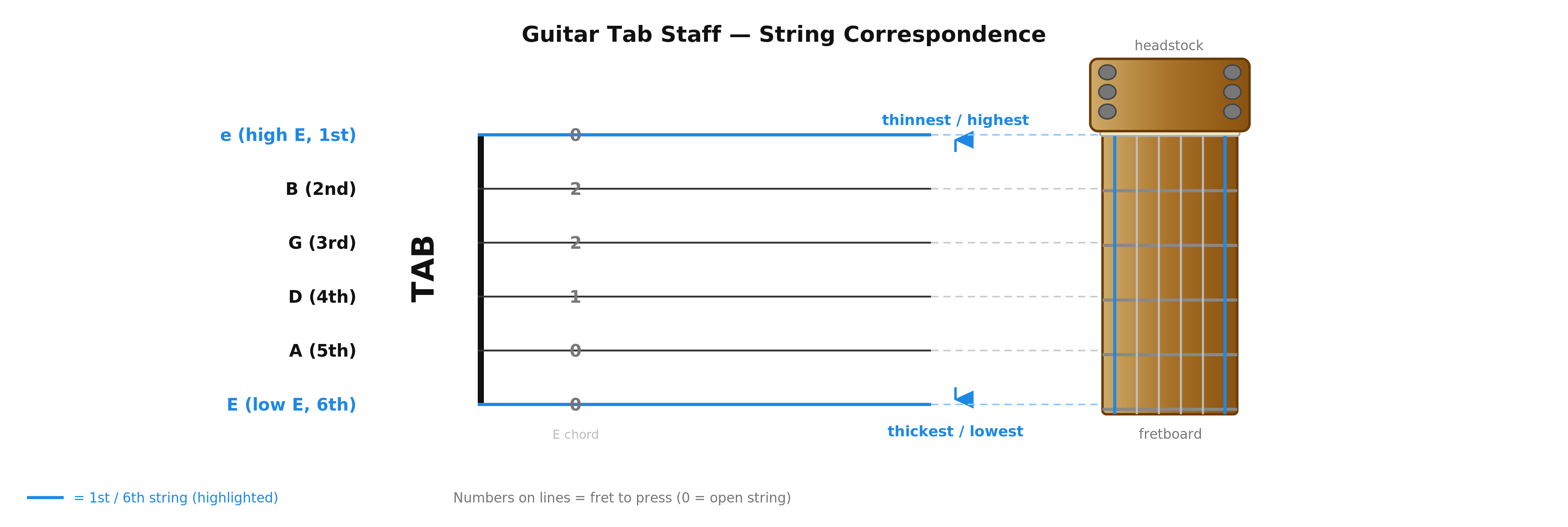
The six lines are your six strings
Each of the six lines represents one string of the guitar. The catch that trips up almost everyone at first is the order: the lines are arranged by pitch, not by their physical position as you look down at the guitar. The top line is the thinnest, highest-sounding string — the high E, or 1st string. The bottom line is the thickest, lowest-sounding string — the low E, or 6th string. So the layout is upside-down compared with looking at your own guitar with the thickest string on top.
In standard tuning, reading the lines from top to bottom, the strings are e–B–G–D–A–E. That spells the six open strings from highest to lowest. If those note names are new to you, the guitar string names guide walks through each one and how to remember the order, and it pairs well with a quick tune-up on the online tuner so your open strings actually match the tab before you start.
The numbers are frets, and zero means open
A number sitting on a line tells you which fret to press on that string, then pluck. The frets are the metal strips along the neck; the space just past the nut is the 1st fret, the next space is the 2nd, and so on up toward the body. A 3 on the top line means “press the 3rd fret of the high E string and play it.” A 0 means play the string open — no finger, just pluck it as it is.
Because the number names the fret directly, tab never asks you to figure out a note name or a key signature. Higher numbers are simply higher up the neck. That directness is the whole appeal, and it is also the reason two very different notes can look almost identical in tab — a 5 and a 6 on the same line are just one fret apart under your finger.
You read tab left to right, in time
Time flows left to right, exactly like standard notation and like reading a sentence. Numbers printed one after another are played one after another, as separate notes. Numbers stacked vertically in a column are played together at the same instant — that vertical stack is how tab writes a chord. So a column reading 0 on the D string, 2 on the G, 3 on the B, and 2 on the high E, all lined up, means strum those four strings at once.
Reading a single-note line, then, is just: find the leftmost number, play that fret on that string, move right to the next number, and keep going. The spacing between numbers hints at rhythm — notes close together tend to be quick, notes spread out tend to be held — but that spacing is only a rough guide, which is the limitation we come back to at the end.
The tab symbol and technique reference
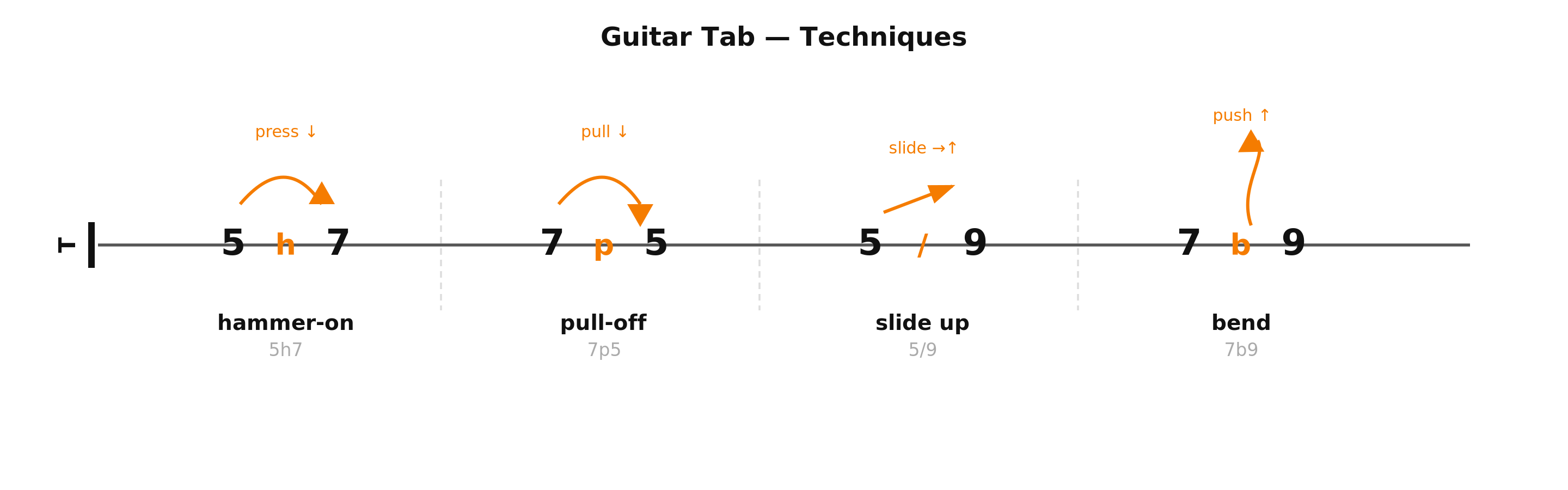
Beyond plain numbers, tab uses a small set of letters and symbols to show how to move between notes — the articulations that give the guitar its voice. These appear between or beside the fret numbers. Here is the complete set you’ll meet in almost every tab, with what each one tells your hands to do.
| Symbol | Name | What it tells you to do | Example |
|---|---|---|---|
| h | Hammer-on | Pluck the first note, then sound the higher note by slamming a finger onto that fret without plucking again. | 5h7 |
| p | Pull-off | Pluck the first note, then sound the lower note by pulling your finger off the string to let the lower fret ring. | 7p5 |
| b | Bend | Play the fret, then push the string sideways to raise the pitch to the target note. | 7b9 |
| r | Release | Let a bent string relax back down to its original pitch. | 7b9r7 |
| / | Slide up | Play the first fret, then slide the same finger up to the higher fret without lifting or re-plucking. | 5/9 |
| \ | Slide down | Play the first fret, then slide the same finger down to the lower fret without lifting or re-plucking. | 9\5 |
| x | Mute / dead note | Rest a finger lightly on the string so it makes a muffled percussive click instead of a clear pitch. | x |
| ~ | Vibrato | Hold the fretted note and wobble the string slightly to make the pitch shimmer. | 7~ |
| PM | Palm mute | Rest the edge of your picking-hand palm on the strings near the bridge for a tight, damped tone; the dashes show how long it lasts. | PM- - - - |
| ( ) | Ghost / grace note | Play the note in parentheses lightly or as a quick lead-in — it’s implied or ornamental rather than fully struck. | 5(7) |
| vertical stack | Chord | Fret numbers lined up in one column are played together as a chord, not one after another. | 2 / 3 / 2 / 0 stacked |
You don’t need to memorize the whole table before you play. Learn to read the numbers first, add hammer-ons, pull-offs and slides next since they show up constantly, and pick up the rest as songs call for them.
Read a real riff: “Smoke on the Water”
The fastest way to make this click is to read something you already know. The main riff from Deep Purple’s “Smoke on the Water” has a well-known beginner arrangement played entirely on one string — the D string, the 4th string, the third line up from the bottom. Here is the tab for that single-string version:
D string: 0–3–5, 0–3–6–5, 0–3–5, 3–0
Read it the way we described: stay on the D-string line and move left to right. Play the open D string (0), then the 3rd fret, then the 5th fret. Pause, then 0–3–6–5. Pause, then 0–3–5 again. Finish with 3, then the open string. Every number is a fret on that one string, every note is played in turn, and the commas just group the phrases so you can hear the shape. This arrangement is transposed to a comfortable beginner key rather than the original recording’s pitch, which is why teachers reach for it first — it lives on a single string and needs no chords.
Notice what the tab gave you and what it didn’t: it told you every finger position with total precision, but you supplied the timing from memory of the song. That is the crux of tab’s one real limitation.
What tab can’t tell you: rhythm
Plain tab shows you which notes to play, but not how long to hold each one. There is no built-in way to tell a note that lasts one beat from a note that lasts four. You can space numbers farther apart to hint at longer notes, but that is an approximation, and it falls apart for anything but simple lines. This is why tab works so well for a riff you already know by ear — you fill in the rhythm yourself — and struggles with music you’ve never heard.
Standard notation solves exactly this. Its note shapes — whole notes, half notes, quarter notes and so on — specify each duration precisely, so you can play a piece correctly the first time without ever having heard it. That is why serious tab often appears with a standard-notation staff printed directly above it: the tab gives you the fret positions, and the notation gives you the rhythm. If you’d like to read that top staff too, the how to read sheet music guide covers note durations and the rest of the system from the beginning.
Try it in a score you can play back
The surest way to check that you’re reading a tab correctly is to hear it played back. Get MuseScore Studio free at musescore.org, where you can type notes onto a tab staff — with the standard-notation rhythm right above it — and play the result instantly, so a misread fret is obvious the moment you hear it. To explore tabs other players have shared and hear how a riff should sound before you learn it, browse and play back scores on musescore.com.
Putting it together
Guitar tab is a picture of the fretboard: six lines for the six strings, high E on top and low E on the bottom, with each number naming the fret to press and zero meaning an open string. You read it left to right, play stacked numbers together as a chord, and use the small set of letters and symbols to shape how each note moves. Learn to read a riff you know, lean on standard notation when you need the rhythm, and you have everything you need to start turning those puzzles of numbers into songs.
Frequently asked questions
How do you read guitar tabs for beginners?
Read the six lines as your six strings, with the high E string on top and the low E on the bottom. Each number is the fret to press on that string, and a zero means play the string open. Move left to right in time, and play any numbers stacked in a vertical column together as a chord.
Which string is the top line in guitar tab?
The top line is the thinnest, highest-pitched string — the high E, or 1st string. The bottom line is the thickest, lowest string — the low E, or 6th string. This is the reverse of how the strings look when you glance down at your own guitar, which is the most common point of early confusion.
What do the letters and symbols in guitar tab mean?
They tell you how to move between notes. The common ones are h for hammer-on, p for pull-off, b for bend and r for release, a forward slash for a slide up and a backslash for a slide down, x for a muted note, a tilde (~) for vibrato, PM for palm mute, and parentheses for a ghost or grace note. Numbers stacked in a column mean a chord.
Can you learn guitar with only tabs?
You can learn to play a lot of songs from tab alone, because it shows exact finger positions without any theory. Its limit is rhythm — plain tab doesn’t tell you how long to hold each note. For songs you don’t already know by ear, pairing tab with standard notation, which specifies durations, fills that gap.
Why doesn’t guitar tab show timing?
Tab was designed to show position on the fretboard, not duration, so it has no built-in way to mark how long a note lasts. Spacing the numbers farther apart only hints at rhythm. That’s why tab is often printed beneath a standard-notation staff, which supplies the exact note lengths.