Easy guitar songs for beginners
·
You’ve got a guitar in your hands, a couple of chords more or less under your fingers, and one very reasonable question: what can I actually play right now that sounds like a real song? Plenty of famous tracks were built on two, three, or four simple chords, which is exactly why they’ve been the first songs guitarists learn for decades.
This guide shows you what makes a song easy for a beginner, then gives you a table of a dozen genuinely simple, well-known songs grouped from two chords up to four. You’ll see the exact chords each one uses, why it’s beginner-friendly, and where a capo fits in — so you can pick one that matches the chords you already know and start playing today.
The short answer: the easiest first songs use just 3–4 open chords and a simple strum, so start with a two- or three-chord staple like “Horse with No Name” or “Three Little Birds” where you can stay on one pattern and focus on changing chords cleanly.
What makes a guitar song easy for a beginner
Three things decide whether a song is realistic for your first weeks, and every song below scores well on at least two of them.
The first is the number of chords. Fewer chords means fewer shapes to memorize and fewer changes to make while the song keeps moving. A two-chord song lets you spend all your attention on one transition until it’s automatic; a four-chord song is still very manageable once those first changes are solid.
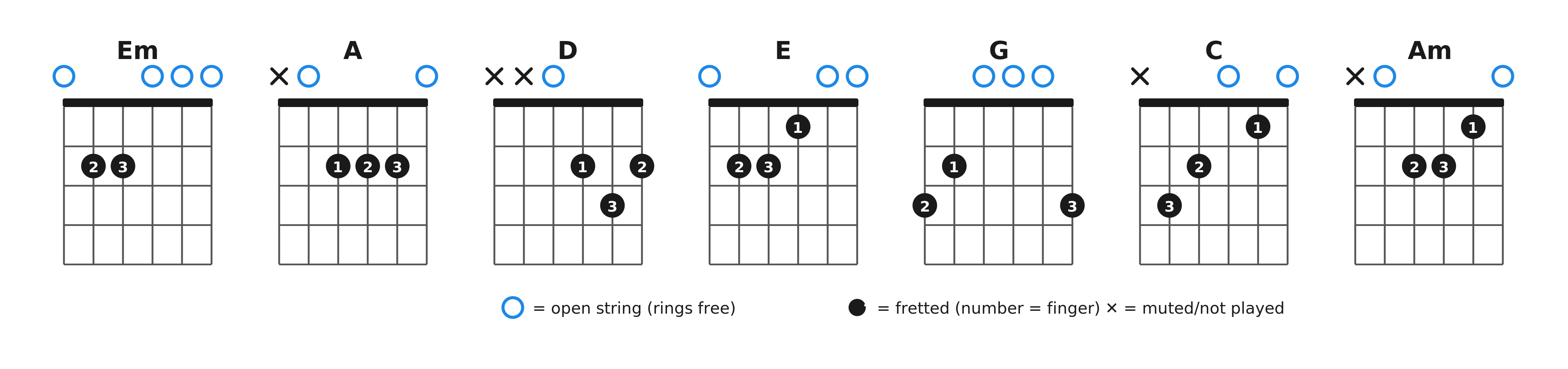
The second is which chords they are. Open chords — shapes played near the top of the neck using open strings, like Em, A, D, G, C, and E — are the beginner’s toolkit because they don’t ask you to bar all six strings with one finger. A song built from open chords is far kinder than one that needs a full F or B barre chord early on.
The third is the strum and the tempo. A slow song gives you time to move between shapes, and a simple, repeating strum — even just steady downstrokes — means your picking hand isn’t fighting your fretting hand for attention. Speed and fancy rhythms can come later; clean chord changes come first.
The easiest first songs, from two chords up
The songs below are grouped by how many chords they use, fewest first. Every chord shown is the standard, commonly-taught open-chord version, and each entry tells you why the song is forgiving to learn. Pick one whose chords overlap with what you already play, and you’ll spend your practice on music instead of memorizing.
Two-chord songs
If you can play two clean chords and switch between them, you can play a song. Start here even if it feels almost too simple — a two-chord song is where clean, in-time chord changes actually get built.
“Horse with No Name” — America
This is the song nearly every teacher reaches for first, and the reason is simple: it rocks between just two shapes, Em and D6/9, over a plain downstrum at a mid tempo. Em is one of the very first open chords anyone learns — two fingers, no barre — and the D6/9 next to it is a compact, easy grab, so the whole song is one change repeated until it feels effortless. That single back-and-forth is exactly the skill it builds: moving cleanly and in time between two shapes without your strum stalling. You know the hook the moment it starts — the rolling, hypnotic verse groove that never really lets up. The one thing to watch is your fretting hand going lazy on the repeat, since the pattern is so steady; keep each chord ringing fully rather than half-pressing as you settle in. Two chords carry the whole track, which is why it has been a first song for decades.
See “Horse with No Name” on MuseScore
“Achy Breaky Heart” — Billy Ray Cyrus
This one does the same job as a two-chord starter, but with A and E — two of the most common open chords and a pair you’ll reuse in dozens of other songs. Both are open shapes with no barre, and they sit close together on the neck, so your hand doesn’t travel far to swap between them. A relaxed country strum keeps the pace easy, and the chords change on a predictable, unhurried schedule, so there’s nothing to rush. The skill here is the A-to-E change, one of the most useful moves to own early because so much blues and country leans on it. The chorus hook — that big, sing-along “don’t tell my heart” line — rides the same two chords, so you’re playing the recognizable part from the start. Watch that every string in your A chord rings clearly; it’s easy to crowd three fingers into one fret and accidentally mute a string.
See “Achy Breaky Heart” on MuseScore
Three-chord songs
The three-chord group is the heart of popular music, because a huge share of songs live on just the I, IV, and V chords of a key.
“Three Little Birds” — Bob Marley
Built on three easy open chords — A, D, and E — this one is famously gentle, and it’s a natural next step once a two-chord song feels solid. None of the three needs a barre, and they’re the same friendly shapes that show up everywhere, so you’re adding one new change rather than a whole new vocabulary. The laid-back reggae tempo leaves long, unhurried gaps between changes, which gives you time to place each shape fully before the next one arrives. That spacing is what it teaches: making a change land right on the beat when you actually have a moment to aim for it. The “don’t worry about a thing” chorus is about as recognizable as a guitar part gets, and it uses the same three chords as the rest of the song. The main thing to watch is timing rather than speed — come in a beat early or late and the easy groove is exactly what exposes it, so count the gaps out loud until the changes feel automatic.
See “Three Little Birds” on MuseScore
“Bad Moon Rising” — Creedence Clearwater Revival
Three bright open chords — D, A, and G — run through a short loop that repeats for most of the song. All three are core open shapes with no barre, and the progression follows the classic D–A–G–D shape that turns up in countless songs, so the pattern feels familiar almost immediately. The strum is simple and upbeat at a moderate tempo, quick enough to feel lively but not so fast that the changes blur. What it builds is fluency in a full three-chord loop rather than a single swap — the same handful of changes coming around again and again until they’re muscle memory. The chugging verse riff and its “I see a bad moon rising” hook are instantly recognizable, and they sit right on top of that loop. The one change to watch is the quick A-to-G move; give it a little extra slow practice on its own so it doesn’t drag the tempo once the song picks up.
See “Bad Moon Rising” on MuseScore
“Sweet Home Alabama” — Lynyrd Skynyrd
The same three-chord loop — D, C, and G — repeats through nearly the whole song, verse and chorus alike. All three are standard open chords with no barre, and because the sequence never really changes, you learn one turnaround and you’ve essentially learned the whole track. That repetition is the payoff for beginners: a small amount of learning covers a lot of song, which makes it a satisfying early win. The skill it drills is a smooth, cycling change through three shapes at a steady mid tempo — exactly the motion most songs ask for. The famous intro riff and that D–C–G turnaround are among the most recognizable sounds in rock, so you’re playing a hook people know from the first bar. The trickiest link is the C-to-G change, where your fingers have to reshape across strings; isolate that one move and drill it slowly on its own before you play the loop up to speed.
See “Sweet Home Alabama” on MuseScore
“Ring of Fire” — Johnny Cash
G, C, and D make up the whole song — the classic I–IV–V trio that anchors more popular music than any other three chords. Every shape is a standard open chord with no barre, and at this moderate tempo the changes are clear and well-spaced, so nothing rushes you. Because the chords are so common, this is a great place to build the three most-used changes at once and get them reliable. The mariachi-flavored horn line and the “burns, burns, burns” chorus are the hooks everyone knows, and the guitar sits right underneath them. It also happens to be an easy song to sing and play together, since the steady pace gives your voice and hands room to line up. The move to watch is G-to-C; it’s one of the most common changes in all of guitar, so drilling it here pays off far beyond this one song.
See “Ring of Fire” on MuseScore
“What’s Up” — 4 Non Blondes
This one cycles G, Am, and C slowly enough that even a hesitant change still lands on time. All three are open shapes with no barre, and the tempo is genuinely forgiving — the chords change once per bar or slower, so you get a full beat to aim for the next shape. That makes it a comfortable place to fold Am into your playing, since a minor chord in the middle of a real song is a milestone worth practicing where you have room to breathe. The skill it builds is confidence moving between major and minor open shapes without breaking the strum. The soaring “hey-yeah-yeah, what’s going on” chorus rides the same G–Am–C loop as the verse, so the whole song is one pattern you already know once the first chorus clicks. Watch the Am-to-C change in particular — the shapes are close and share a finger, so keep your first two fingers relaxed and let them shift together rather than resetting from scratch.
“Twist and Shout” — The Beatles
Three open chords — D, G, and A — climb in one pattern that repeats all song long. They’re the same core open shapes with no barre, and they move in a rising D–G–A order that falls naturally under the hand once you’ve played it a few times. Because the sequence never changes, you learn it once and ride it from the first verse to the last, which makes it a confidence-builder more than a memory test. What it teaches is keeping a steady, driving strum going while the chords cycle — the energy of the song comes from the rhythm hand not stopping. The build-up section, where the “ahh” vocals climb before crashing back into the riff, is the hook everyone waits for, and it’s built on the very same three chords. The thing to watch is stamina: the relentless pace can tire your strumming arm, so drive it loosely from the wrist rather than the elbow so you can hold the tempo to the end.
See “Twist and Shout” on MuseScore
Four-chord songs
Four chords open up a big catalog while still staying beginner-friendly, because the extra chord is usually one you already know.
“Knockin’ on Heaven’s Door” — Bob Dylan
Four open chords — G, D, Am, and C — sit in a slow, two-bar pattern that never changes for the whole song. Every shape is a beginner staple with no barre, and the progression moves G–D–Am and then G–D–C in a gentle, predictable swing, so the fourth chord adds almost nothing over a three-chord song. The slow tempo and constant repetition make it one of the easiest four-chord songs to play end to end. It’s a natural first four-chord song because it teaches you to hold a longer loop in your head without any single change being hard. The “knock, knock, knockin’ on heaven’s door” chorus uses the same pattern as the verse, so there’s no new section to learn once the loop is down. Watch the D-to-Am change, where your fingers shift as a group; take it slowly on its own and the rest of the loop carries itself.
See “Knockin’ on Heaven’s Door” on MuseScore
“Let It Be” — The Beatles
C, G, Am, and F cycle at a gentle, steady tempo that gives you room to think between changes. Three of the four — C, G, and Am — are open shapes you likely already know, so most of the song sits on comfortable ground. Its one sticking point is the F chord, which asks for a small barre where your index finger presses two strings at once, and it’s the reason this song is such a common first step toward barre chords. That’s exactly what it teaches: an early, low-stakes introduction to barring, surrounded by easy shapes so you’re not fighting the whole song at once. The descending progression under “let it be, let it be” is instantly recognizable, and it stays in the same C–G–Am–F family throughout. When you reach the F, roll your index finger slightly onto its side and keep it close to the fret; if the full shape buzzes, a partial two- or three-string F still keeps the song moving while your hand builds strength.
“With or Without You” — U2
A single four-chord loop — D, A, Bm, and G — carries the entire track from start to finish, with no bridge or second progression to learn. Three of the four are easy open chords, and the loop stays in the same D–A–Bm–G order the whole way through, so the structure couldn’t be simpler. The one challenge is Bm, which needs a partial barre, but that’s actually why this song is such a good place to meet it: the shape comes back every few seconds for four minutes, so you get endless reps on the same change instead of one rare, scary appearance. What it builds is comfort with a small barre inside a slow, repetitive loop where you always know it’s coming. The atmospheric, swelling chorus everyone recognizes rides that identical four-chord cycle, so the peak of the song uses the same shapes as the quiet intro. For the Bm, keep your index barre light across the top strings and let the slow tempo give you time to set it — if it buzzes at first, the constant repetition means the next clean attempt is only seconds away.
See “With or Without You” on MuseScore
“Wonderwall” — Oasis
With a capo on the second fret you play comfortable shapes — Em7, G, Dsus4, and A7sus4 — while the song sounds in a harder key that would otherwise need awkward chords. None of these needs a full barre, and the strumming pattern stays constant while the chords change, so the song is more about rhythm than difficult grips. What makes it special for beginners is a fingering trick: these shapes share fingers, so you can leave your ring and pinky planted on the top two strings and just move the others, which turns the changes into small adjustments rather than full resets. That’s the skill it teaches — economy of motion, plus getting comfortable using a capo to unlock a whole key. The chiming intro and the “and after all” chorus are among the most recognizable acoustic parts around, and they use these same capo shapes throughout. The two things to watch are the capo and the strum: clamp the capo just behind the second fret so nothing buzzes, and keep your strumming hand moving in a steady, even pattern even while the shapes shift underneath it.
Where a capo fits in
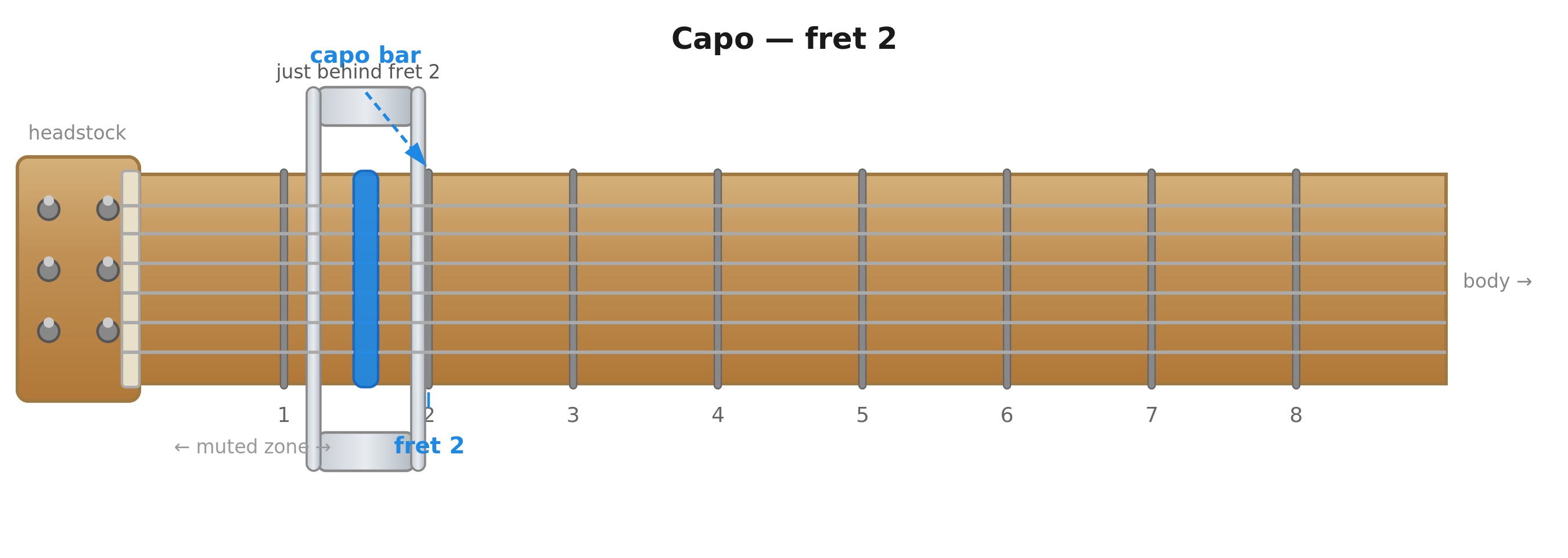
A capo is a spring- or screw-clamp that presses down all six strings at one fret, effectively giving you a new nut higher up the neck. It matters for beginners because it lets you play easy open-chord shapes while the song sounds in a different, often harder key. You keep fingering the shapes you know; the capo raises the pitch.
“Wonderwall” is the classic example: with a capo on the second fret you play comfortable shapes — Em7, G, Dsus4, A7sus4, and Cadd9 — that would otherwise require awkward chords to reach the same key. Clamp the capo just behind the fret (not on top of it) so every string rings cleanly, and treat the capo’s fret as your new “zero.” Once a song sounds right with open shapes plus a capo, it belongs on your beginner list even if its actual key looks intimidating on paper.
How to learn one of these songs
Picking the song is the easy part. This order turns it into something you can actually play through, and it works for any song in the table.
- Tune first, every time. A song only sounds right if the guitar is in tune, and your ear can’t learn the chords from out-of-tune shapes. Use the online tuner before each session — it takes ten seconds and saves you from practicing a wrong sound.
- Learn the chord shapes on their own. Take just the chords the song uses and hold each one until every string rings clear. If a note buzzes or thuds, adjust a fingertip until it doesn’t. Getting one clean shape is worth more than rushing through all of them.
- Drill the changes slowly. Switch between two chords at a time, as slowly as you need, aiming for a smooth move rather than a fast one. Speed comes free once the motion is familiar; a rushed, sloppy change never gets cleaner on its own.
- Add a simple strum. Start with steady downstrokes on the beat, one per chord, then add an up-strum only when the downs feel automatic. Keep the strumming hand moving evenly even while your fretting hand catches up.
- Play along slowly. Put on the track (or a slowed-down version) and play the chords in time, missing some and catching the next one. Playing along teaches timing better than any drill.
If the chord names or the numbers in a songbook look unfamiliar, two short guides make the rest click: how to read guitar tabs explains the diagrams and tablature you’ll see everywhere, and the guitar string names guide gets you oriented on which string is which so chord shapes make sense.
Get set up to practice and play along
When you want to see a song’s chords on the staff, hear them played back at any tempo, and slow a tricky change down without it turning to mush, get MuseScore Studio free at musescore.org — you can enter the chords, loop a section, and drop the tempo so your hands can keep up, then bring it back to speed. To hear how other players arrange these same songs, browse and play back scores on musescore.com and follow along with the chords.
Wrapping up
Every song in that table earns its spot the same way: a handful of open chords, a slow-to-moderate tempo, and a pattern that repeats so the music comes back to you long before the end. Start with two chords, get the change spotless, then let each new song add one shape at a time. The famous songs aren’t harder than the exercises — they’re the reward for the same small, steady practice.
In short: the easiest first songs use 3–4 open chords and a simple strum, two-chord tracks like “Horse with No Name” are the place to begin, a capo lets easy shapes cover harder keys, and the fastest way to sound like a song is to tune up, learn the shapes clean, and drill the changes slowly before you add speed.
Frequently asked questions
What is the easiest song to learn on guitar?
“Horse with No Name” by America is the most common first song, because it uses only two chords — Em and D6/9 — over a steady downstrum, so all your attention goes to one clean chord change. “Achy Breaky Heart” (A and E) is an equally simple two-chord option.
How many chords do you need to play most songs?
Three or four open chords cover a huge share of popular music. Many songs live on the I, IV, and V chords of a key — for example G, C, and D — and a fourth chord like a minor (Am or Em) opens up most of the rest. All twelve songs in the table above use four chords or fewer.
Which chords should a beginner guitarist learn first?
Start with the open chords Em, A, D, E, G, C, and Am. They’re played near the top of the neck using open strings, so they don’t require barring, and nearly every beginner song is built from this small set. Once those feel clean, add the F chord, which uses a small barre.
Do I need a capo to play beginner songs?
No — most beginner songs need no capo at all. A capo simply clamps all the strings at one fret so easy open shapes sound in a higher key, which is why songs like “Wonderwall” are taught with a capo on the second fret. It’s a helpful tool, not a requirement, and you can skip it until a song calls for one.
How long does it take to play your first song on guitar?
Many beginners can play through a two- or three-chord song within their first few weeks of regular practice. The pace depends on getting each chord to ring clearly and switching between shapes in time, not on natural talent — short, daily sessions on clean chord changes get you there faster than occasional long ones.
See scores on MuseScore
- A Horse with No Name — America
- Achy Breaky Heart — Billy Ray Cyrus
- Three Little Birds — Bob Marley
- Bad Moon Rising — Creedence Clearwater Revival
- Sweet Home Alabama — Lynyrd Skynyrd
- Ring of Fire — Johnny Cash
- What's Up — 4 Non Blondes
- Twist and Shout — The Beatles
- Knockin' on Heaven's Door — Bob Dylan
- Let It Be — The Beatles
- With or Without You — U2
- Wonderwall — Oasis