What is the chromatic scale?
·
Most scales you meet early on pick out seven notes from the twelve available and leave the rest behind — that selection is what gives C major or A minor its particular character. The chromatic scale does the opposite: it keeps every note. Play from any key to the one right beside it, over and over, and you are playing chromatically. It sounds less like a “key” and more like a smooth slide up or down the keyboard, and that is exactly the point.
This guide explains what the chromatic scale is, why it’s built entirely of half steps, and why it has no home note the way major and minor scales do. You’ll get the full twelve-note scale spelled out in both directions, the spelling rule that keeps it readable, a practical piano fingering, and a famous piece that shows it off.
The short answer: the chromatic scale is the set of all twelve pitches within an octave, each one a half step apart. Because it uses every available note in equal steps, no single note stands out as “home,” which is what sets it apart from every other scale you’ll learn.
What the chromatic scale is
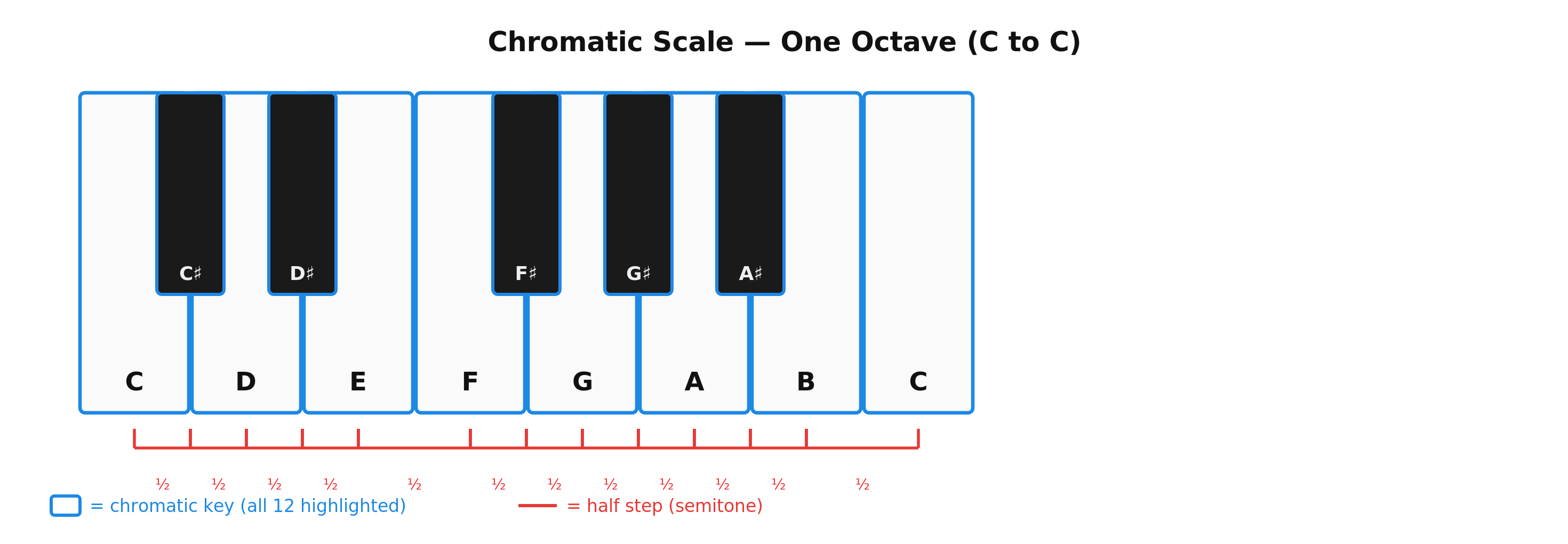
An octave — the distance from one C to the next C, say — is divided into twelve equal half steps on a piano. A half step, also called a semitone, is the smallest distance between two notes: from any key to the very next key, black or white, with nothing in between. Most scales skip some of those twelve notes to build a pattern. The chromatic scale skips nothing. Starting on C, you play C, C♯, D, D♯, E, F, F♯, G, G♯, A, A♯, B, and land on the next C — every white and black key in order.
The name comes from the Greek word chroma, meaning color. Musicians think of the extra notes — the ones a plain major scale leaves out — as adding color to a line, which is why passing through them is described as chromatic movement. You’ll hear a chromatic run as a continuous, gliding rise or fall, because there’s no gap wider than a half step anywhere in it.
Why it’s built entirely of half steps
Every scale is really a recipe of steps. A major scale mixes whole steps and half steps in a fixed order; a natural minor scale uses a different order of the same two ingredients. The chromatic scale uses only one ingredient: the half step, twelve times in a row. That single rule is the whole definition — move by a half step, again and again, until you arrive back at your starting note an octave higher or lower.
This is why the chromatic scale sounds so even. In a major scale, the mix of whole and half steps creates points of tension and rest — some notes pull strongly toward others, which is what gives the scale its sense of a home base. Chromatic motion flattens that out. Because every step is the same size, no note leans harder than any other, and the line just glides. Composers use that quality on purpose: a chromatic run raises tension smoothly without committing to any key, which makes it a handy way to connect two ideas or build excitement before a resolution.
Why the chromatic scale has no single key or tonic
Most scales are named after their tonic — the note that feels like home, the one your ear keeps wanting to return to. C major is built around C; A minor is built around A. That home note gets its authority from the pattern of unequal steps around it, especially the half step just below it (the leading tone) that pulls strongly upward into it.
The chromatic scale has no such pattern, because every step is identical. Nothing sets one note above the rest, so there is no tonic and, strictly speaking, no key. A “C chromatic scale” and a “D chromatic scale” contain exactly the same twelve pitches — the only difference is which note you happen to start counting from. That’s why you’ll rarely see a whole piece written in “the chromatic scale.” Instead it appears as a passage inside music that does have a key, coloring a melody or linking two chords before the music settles somewhere.
How to spell the chromatic scale: sharps up, flats down
Here’s a wrinkle that trips up a lot of students. The black key between C and D can be called C♯ (C-sharp) or D♭ (D-flat) — same key, two names. These two-name notes are called enharmonic equivalents. So which name do you write?
The standard convention is simple: use sharps when ascending and flats when descending. Going up, each black key is spelled as a sharp of the note below it (C♯, D♯, F♯, G♯, A♯); coming down, each is spelled as a flat of the note above it (D♭, A♭, G♭, E♭, B♭). This keeps the written line easy to read, because the accidentals point in the same direction the music is moving. It also avoids awkward spellings — you never need to write E♯ or C♭ in a plain chromatic scale, since those are just F and B under a confusing name.
The table below shows the complete scale from C, both directions. Read each column top to bottom as its own line: the left column climbs an octave with sharps, and the right column descends the same octave with flats. The step number is simply the order in which you play the notes for that direction.
| Step | Ascending (sharps) | Descending (flats) |
|---|---|---|
| 1 | C | C |
| 2 | C♯ | B |
| 3 | D | B♭ |
| 4 | D♯ | A |
| 5 | E | A♭ |
| 6 | F | G |
| 7 | F♯ | G♭ |
| 8 | G | F |
| 9 | G♯ | E |
| 10 | A | E♭ |
| 11 | A♯ | D |
| 12 | B | D♭ |
| C (octave) | C | C |
Notice that the two columns never share a name in the same row except at the start and finish — that’s the sharp/flat convention doing its job. C♯ ascending is the same key as D♭ descending; D♯ is the same key as E♭; F♯ is the same as G♭; G♯ is the same as A♭; and A♯ is the same as B♭. Same twelve keys under your fingers, spelled to match the direction of travel.
This convention is a guideline, not an unbreakable law. Inside real music, the surrounding key sometimes makes the opposite spelling clearer, and an editor will spell a note to fit the harmony around it. But for writing out the scale on its own — the version you’ll practice and the version examiners expect — sharps up and flats down is the rule to follow.
How to play the chromatic scale on piano
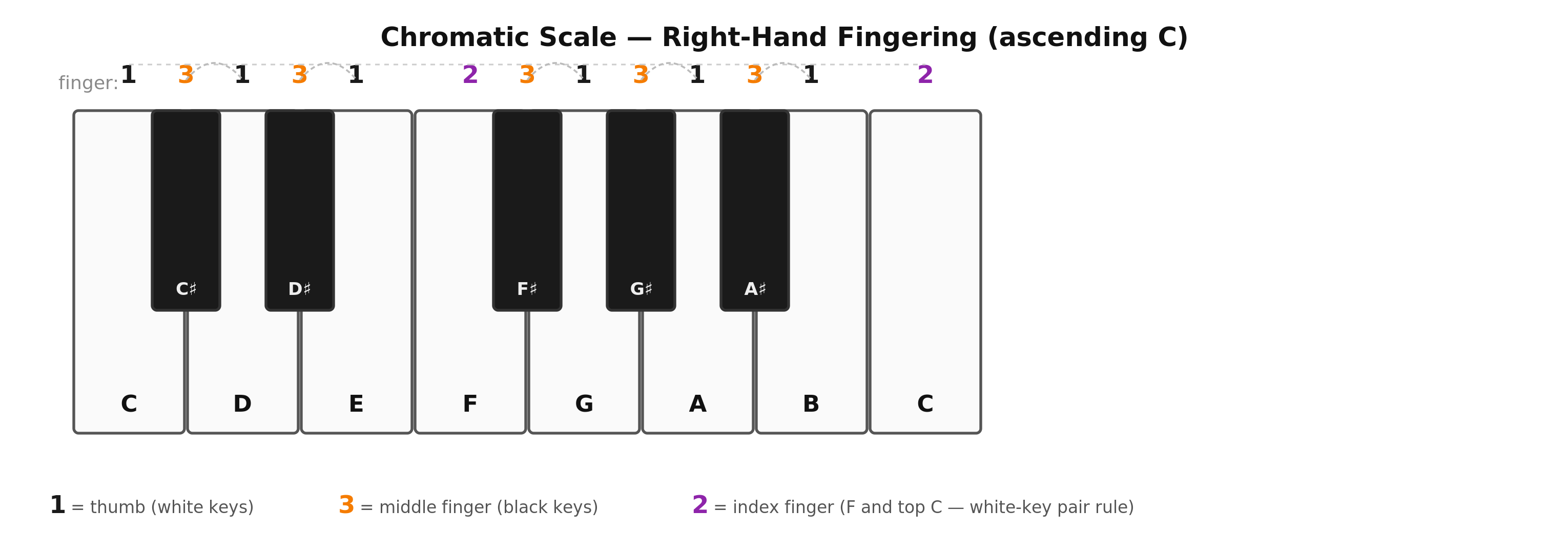
Because the chromatic scale touches every key, the fingering has to glide over black and white keys without twisting your hand. Fingers are numbered 1 to 5 from the thumb, so the thumb is 1, the index 2, the middle 3, the ring 4, and the little finger 5. The chromatic scale uses only fingers 1, 2, and 3, and it follows three clear rules:
- Finger 3 plays every black key. The middle finger is long enough to reach back to the black keys without the hand lunging.
- Finger 2 plays the second of any two white keys that sit next to each other — the pairs E–F and B–C, where there’s no black key between them.
- The thumb (1) plays every other white key.
Applied to the right hand ascending from C, those rules produce this fingering: 1-3-1-3-1-2-3-1-3-1-3-1-2. In note terms, that’s thumb on C, 3 on C♯, thumb on D, 3 on D♯, thumb on E, then 2 on F (because E and F are adjacent white keys), 3 on F♯, and so on up to 2 on the top C. Coming back down, you reverse the same logic — the black keys still take finger 3, and finger 2 handles the white-key pairs. Keep your wrist level and let the hand move as one smooth unit rather than reaching with individual fingers; an even, unhurried tempo matters far more than speed while the pattern settles in.
Where you’ll actually hear it
The most famous example is “Flight of the Bumblebee” by Nikolai Rimsky-Korsakov, written for his opera The Tale of Tsar Saltan. Its buzzing, restless melody is built largely from fast chromatic runs racing up and down, and that unbroken half-step motion is exactly what makes it sound like an insect darting through the air — there’s no resting note for the ear to settle on. It’s the piece people most often reach for when they want to hear the chromatic scale doing real musical work.
You’ll also find chromatic movement threaded through jazz, blues, and film scores, usually as a short connecting run rather than the whole tune. Once you know the sound — that smooth, keyless glide — you start hearing it everywhere: a singer sliding between two pitches, a bass line creeping down a half step at a time, a horn section building tension before a big chord. To see how the twelve notes lay out under your hand before you play a run like that, the virtual piano lets you click through the scale one half step at a time right in your browser.
Write and hear it in MuseScore Studio
The fastest way to make the chromatic scale click is to write it out and play it back. Get MuseScore Studio free at musescore.org, enter the twelve notes on the staff, and press play — you’ll hear the even, gliding half steps immediately and catch any wrong note the moment you write it. The app also handles the sharp/flat spelling for you as you go, so you can see the convention in action. To hear how composers fold chromatic runs into full pieces, browse and play back scores on musescore.com.
How the chromatic scale fits with the others
The chromatic scale is the full palette — all twelve colors. Every other scale you learn is a selection from it. If you compare it with major and minor scales, you can see exactly which notes each one keeps and which it leaves out, and why that choice gives major its brightness and minor its darker cast. The melodic minor scale is a good next step, because it famously changes its notes depending on whether you’re going up or down — the same direction-aware thinking you just used for chromatic spelling. And once you want to see how the twelve notes organize into keys and which keys sit closest together, the circle of fifths is the map that ties it all together.
Wrapping up
The chromatic scale is the simplest scale to define and one of the most useful to know: twelve pitches, each a half step apart, using every key in the octave. Because those steps are all equal, it has no home note and belongs to no key, which is why you meet it as a coloring device inside other music rather than as a piece of its own. Spell it with sharps going up and flats coming down, play it with finger 3 on the black keys and the thumb on the whites, and you’ll have the whole system in your hands.
Frequently asked questions
How many notes are in the chromatic scale?
Twelve. The chromatic scale includes every pitch within an octave, each one a half step apart — all seven white keys and all five black keys on a piano. Counting the return to your starting note an octave higher, you play thirteen notes, but there are twelve distinct pitches.
Why does the chromatic scale use sharps going up and flats coming down?
It keeps the written notes easy to read. Ascending, each black key is spelled as a sharp of the note below it; descending, each is spelled as a flat of the note above it, so the accidentals point the same way the music moves. It also avoids confusing spellings like E♯ or C♭, which are really just F and B.
What is the difference between a chromatic scale and a major scale?
A major scale selects seven of the twelve notes using a fixed mix of whole and half steps, which creates a clear home note (the tonic). A chromatic scale uses all twelve notes in equal half steps, so no note stands out as home and it belongs to no single key.
Does the chromatic scale have a key or a tonic?
No. Because every step is the same size, no note is pulled toward as a home base, so the chromatic scale has no tonic and no key. A chromatic scale starting on C contains the same twelve pitches as one starting on any other note — only the starting point differs.
What is a good piece to hear the chromatic scale in action?
“Flight of the Bumblebee” by Nikolai Rimsky-Korsakov is the classic example. Its rapid runs up and down are built largely from chromatic half steps, and that unbroken motion is what gives the piece its buzzing, restless character.